
Same-day service guaranteed

Soakaway Installation & Repair.Built to the regs.Sized to your ground.

From new-build crate soakaways and rainwater off driveways to failed Victorian rubble pits causing standing water — we test, size, build and certify to Building Regulations Part H.

35+ years on the tools · Same-day service guaranteed · Fully insured domestic & commercial

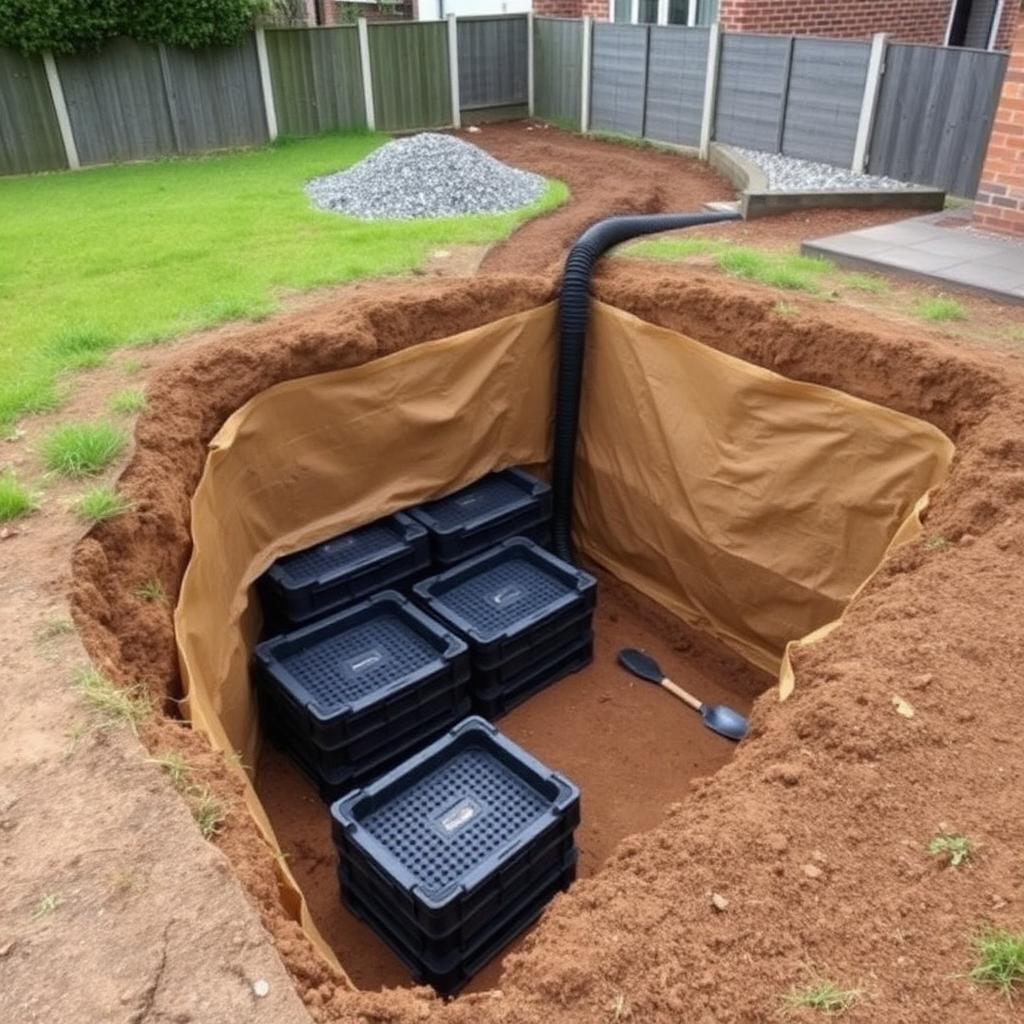
Newly excavated UK garden soakaway with black plastic soakaway crates wrapped in geotextile membrane being installed — soakaway installation and repair

35+

Years on the tools

Guaranteed

Same-day response

£5M PL

Fully insured

CO5 8DX

Local to West Mersea

Overview

Soakaway Installation Essex — what it is, who it's for, when it's needed.

What a soakaway actually is

A subsurface void that takes surface water (and on off-mains property, the outflow from a septic tank) and lets it disperse into surrounding ground at a controlled rate. Done right, you never see it; done badly, you get a wet garden, a saturated driveway, or a foul-water surface every winter.

Who calls us

Homeowners with standing water on lawns and drives after every heavy rain, self-builders and extension projects needing Part H sign-off, landlords with failing Victorian rubble pits, septic-tank property owners whose secondary treatment soakaway has reached end of life, and developers needing a percolation test and BRE 365-compliant design.

When you need it

Standing water after rain that hasn't drained 24 hours later. Foul smell or surface water around an older soakaway location. A planning condition requiring soakaway calculations. A new build, extension or driveway resurfacing project. A failed septic system where the outflow soakaway is the culprit. Sale CCTV flagging soakaway issues.

Why a specialist matters

Soakaways have to be sized to the ground using BRE 365 percolation testing and Part H of the Building Regulations. Skipping the percolation test and 'fitting what came on the lorry' is why so many soakaways fail inside five years. We test, calculate, size, build and certify — and we don't quote until the ground tells us what it can take.

What happens if it's ignored

The cost of waiting.

A failing or undersized soakaway is the slowest, most expensive drainage problem to ignore. Here's why:

Common mistakes we see

  • Skipping the BRE 365 percolation test — fitting the wrong size, every time.
  • Connecting surface water to foul drains — illegal, fills the sewer, and a fine waiting to happen.
  • Reusing an old Victorian rubble pit — collapses or silts up within a year.
  • Installing a single crate where calculations need ten — the soakaway fails in the first wet winter.
  • Building too close to foundations — Part H requires minimum 5m offset.

Garden and driveway flooding

Standing water destroys lawns, kills planting, lifts block paving and freezes into trip hazards in winter.

Septic outflow surfacing

On off-mains property, a failed secondary soakaway pushes partially-treated foul water to the surface — a notifiable environmental incident.

Subsidence and structural risk

Persistent saturation around foundations causes heave, settlement and movement claims that dwarf the original soakaway bill.

Planning and sale obstacles

Part H non-compliance flagged at sale, building control sign-off refused on extensions, mortgage retentions held.

Our process

A clear, documented system — every visit, every job.

  1. 01

    1. Phone diagnosis

    Two-minute call with Matt to scope the symptoms, agree an ETA and confirm pricing brackets before we leave the yard. No call-out fee for the conversation.

  2. 02

    2. On-site inspection

    We lift covers, run flow tests and — where relevant — drop the CCTV camera in to identify the actual cause, not the easiest symptom.

  3. 03

    3. Fixed written quote

    Itemised price covering parts, labour, disposal and timeline. You approve in writing before any tools come out of the van.

  4. 04

    4. Service execution

    Work carried out cleanly: dust sheets, tool mats and bagged waste. We protect floors, gardens and driveways throughout.

  5. 05

    5. Test, photograph, sign-off

    Post-works flow test, CCTV verification where appropriate, photos and a written job sheet emailed within 24 hours plus our workmanship guarantee.

Benefits

What you actually get.

BRE 365 percolation testing

Three-pit, multi-trial percolation test on site — the only way to size a soakaway honestly. Calculations supplied in writing.

Part H compliant design

Sized to your ground, your roof area and your local rainfall — Building Regulations compliant and signed off.

Modern crate construction

Black plastic stormwater crates wrapped in non-woven geotextile, properly bedded and backfilled — 50-year design life.

Failed soakaway repair

Old rubble pits, collapsed Victorian soakaways and silted crate systems — excavated, sized correctly and rebuilt.

Septic soakaway compliance

Off-mains secondary soakaways built to the 2020 General Binding Rules — surveyed, certified and Environment Agency-compliant.

Full reinstatement

Lawn made good, block paving relaid, fences reinstated — site left as found, not as a building site.

In depth

Materials, methods and variations.

A soakaway is engineered, not 'dug'. Get the calculations right and it works silently for 50 years. Get them wrong and it fails in the first wet winter — usually exactly when you can't fix it. Here's how we approach it across Essex, Suffolk and London.

Discuss your project

Percolation testing — the bit most installers skip

BRE Digest 365 sets out the test: three pits, three fills, time the drop from 75%-to-25%-full. The slowest of the three runs sets your design rate. On Essex London clay you might get a Vp of 200 minutes per metre — three times the soakaway you'd expect. On sandy Suffolk loam you might get Vp 20 — a quarter the size. Without the test, you're guessing.

Sizing calculations — Part H Appendix H3

Storage volume = impermeable area × 10mm rainfall depth, with safety factor for soil percolation rate. We supply the calculations in a form your building control officer accepts. Honest sizing means honest cost — undersize and you'll be back in three years.

What we install

Modular plastic stormwater crates (Polypipe Polystorm, Wavin Aquacell or equivalent), wrapped in 200gsm non-woven geotextile, on a 150mm pea-shingle bed, backfilled in 200mm layers. Minimum 5m offset from any building, 2.5m from boundary. Inlet manhole with rodding access and silt trap to extend service life.

Repair work — what we find

1950s-and-earlier brick or rubble-filled pits collapsed inwards. Crate systems installed without geotextile that silted up in 2 years. Soakaways receiving foul water as well as surface water (illegal, and the soakaway can't cope). Soakaways installed in heavy clay where a 30m attenuation pipe to a watercourse was the right answer instead. We diagnose first, quote second.

Septic soakaways under the 2020 rules

If your septic tank discharges to a soakaway, the 2020 General Binding Rules apply. Discharges to surface water are no longer legal. We survey, advise and where needed install a compliant drainage field with the right offsets, percolation rate and capacity. Documented for sale and for the Environment Agency.

Areas covered

Colchester, Essex, Suffolk & London.

FAQ

Soakaway Installation & Repair straight answers.

Still unsure? Call 07736 879575 — no obligation.

  • A new surface-water crate soakaway for a typical 80m² roof, on average ground, runs £1,800–£3,500 including percolation testing, materials and reinstatement. Septic drainage fields and large commercial soakaways quoted on site after testing.
Same-day service guaranteed

Need soakaway installation & repair in Essex? Let's sort it today.

Call Matt direct or request a written quote — we'll come back to you fast.

Clear Drains 4 U · West Mersea, Colchester CO5 8DX · 35 years' experience